
Label errors in the warehouse: what they cost and how to prevent them
The reprint costs cents, the rework costs hours. What label errors really cost, where they come from, and how to prevent them structurally.
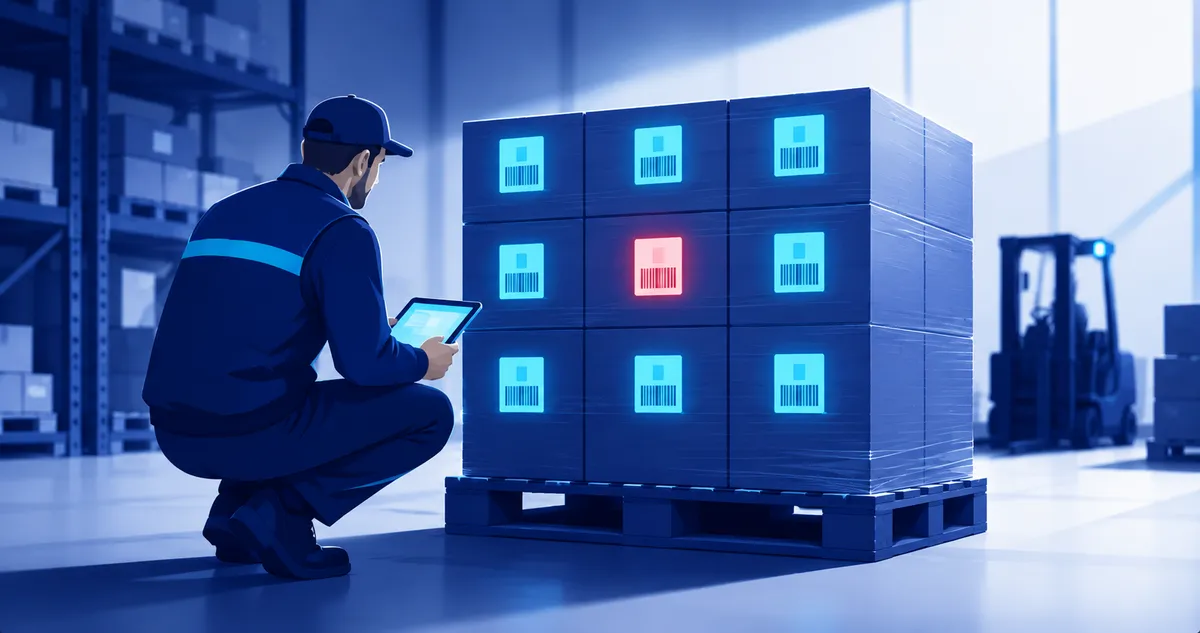
A wrong label looks like a small problem. Reprint it, done. But add up the real costs and most people are surprised: label errors easily cost an average warehouse tens of thousands of euros per year. In this article we do the math and show where the errors come from.
What a label error really costs
The reprint itself is the smallest amount: a few cents of material. The real cost is the time around it. Someone has to spot the error, find the right label, reprint it, and re-apply it. Count on ten to fifteen minutes per incident.
Then there are the errors nobody catches in time. A pallet with a wrong GS1 label comes back from the retailer, often with a fine on top. A shipment to the wrong address costs you an unhappy customer. In pharma and food, a wrong label can even mean a recall.
A worked example: at 2,000 labels per day and a 2% error rate, you lose about 2,500 hours per year to rework. At an hourly rate of 45 euros, that's well over a hundred thousand. Fill in your own numbers with our ROI calculator; it takes 30 seconds.
Where label errors come from
In practice we see four recurring causes:
- Manual entry. Someone retypes order data into the labeling program. People make typos, especially under time pressure.
- Outdated templates. Every department or site has its own copy of the label file, and not every copy gets updated.
- Local files. Labels live on the PC next to the printer. If that PC dies or the employee leaves, nobody is sure which version was the right one.
- Wrong printer settings. The same label prints just slightly differently on another printer, and a shifted barcode no longer scans.
How to prevent them
The common thread in those causes is decentralized management. The solution, then, is centralization. One place for all templates, so a change applies everywhere at once. Data straight from the ERP instead of retyped. And an approval workflow, so a changed label is checked before it goes into production.
That's exactly what Loftware Cloud does. How to approach it with your existing ERP is covered in our article on connecting labeling software to your ERP. Working with GS1 labels? Also read our practical guide to SSCC, GTIN, and GS1-128.
Frequently asked questions
What's a normal error rate in labeling?
With manual entry we see 1 to 3% in practice. With central templates and ERP data it drops to nearly zero, because the two biggest error sources disappear.
Our errors are usually caught internally. Is it still a problem?
Internally caught errors still cost rework time, and those hours add up. Besides, it's a matter of time before one slips through to a customer.
Does better equipment help against label errors?
Partly. A good printer prevents print defects, but most label errors are data errors. You solve those with central management, not hardware.
Conclusion
Label errors aren't a force of nature. They come from manual entry and scattered management, and both can be fixed. Curious what it would save in your situation? Start with the ROI calculator, or book a demo and see how central label management works with your own labels.